Atlantic Ocean
The Salt PathThe Atlantic Ocean is not a distant backdrop to the walkers’ journey but an active presence along its western coast: shaping the land, dictating exposure to wind and weather, and offering moments of exhilaration, vulnerability, and communion. Its changing edge gives the route both a physical direction and a recurring measure of what the walkers can endure or choose for themselves.
The ocean as a coastal threshold
At a viewpoint where the Bristol Channel gives way to the Atlantic Ocean, the walkers eat mozzarella, basil, and tomato paninis with the wind in their faces. The meal becomes inseparable from the setting: gulls wheel overhead, sea spray drives upward from the railings, and tides, wind, and tectonic forces meet in a tumult the narrator understands as a place of beginnings and endings. The boundary between channel and ocean is therefore more than a point on a map. It marks a transition into a coast where the natural forces around them seem to gather and intensify.
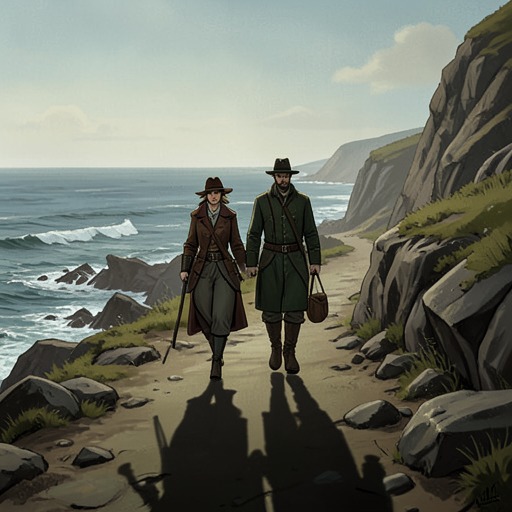
The direction of travel makes that threshold tangible. After the viewpoint, the walkers turn south, following ground that rises and falls through shallow-soiled valleys and exposed rocky headlands. An outcrop known as the Cow and Calf recedes behind them as the next headlands appear. At dusk, they reach open cliff-top grass; a ruined tower frames the fading light and Stoke Church, but its uncertain stability makes it an unreliable shelter. They pitch the tent facing the Atlantic air instead, exposed to the wind crossing the cliff. The ocean is present even when it cannot be seen directly: it determines the direction of the weather and the conditions under which they sleep.
Weather, exposure, and chosen movement
The sea-facing route repeatedly puts bodily experience into direct contact with the Atlantic’s force. Near Land’s End, the cliffs rise in castellated granite, struck by seas arriving from the deep Atlantic. At the Armed Knight Rock Arch, water surges through the offshore opening in immense plumes. The walkers stand exposed on the grass-and-stone headland with no trees or shelter, carrying only a little food: a Mars bar, rice, a banana, and some wine gums. They hide their tent among rocks as the light fades, with only two sheets of nylon between them and Canada. The scale of the ocean and the smallness of their shelter meet in a precise, practical predicament.
That exposure is also bound to a choice about continuing. In mid-September, after rain has soaked their packs, the walkers could stop, but instead put the packs back on and choose to walk. They understand the coast as a place where they retain control over whether to continue or pause, unlike the strain of relying on friends or family until welcome might wear thin. Their freedom is real but not comfortable: they are hungry, cold, and battered by the elements. The Atlantic-facing cliffs do not remove the material limits of their life; they make the walkers’ decision to proceed visible against them.
Night water and shared presence
The ocean’s character changes after dark. In one evening swim, Moth moves through cool, deep water where the day’s warmth lingers in pockets. Grey forms bob nearby; their white heads catch the moonlight, and they occasionally turn toward him without alarm. The passage does not identify them, leaving the encounter with the sea’s other inhabitants quietly open rather than turning it into a claim of mastery or a spectacle. In the water, the walkers’ surroundings seem to loosen and recede until the moon, the salt water, and the murmuring forms remain.
This immersion contrasts with the exposed tent and the hard work of the route. The ocean can make the walkers vulnerable to weather, but it can also briefly suspend the demands of moving, feeding themselves, and finding somewhere to sleep. The night does not resolve their uncertainty: the gulls settle into their rhythm, and the walkers eventually return to the tent. Instead, the encounter offers a moment of shared presence within a landscape that is not theirs to control.
A coast bearing human histories
The Atlantic-facing landscape carries histories of work and damage alongside its natural power. At Cape Cornwall, the walkers sit against the warm granite of a mine chimney and look toward the horizon. The headland’s old name, Kilgooth Ust, is glossed as goose’s back of St Just; to the narrator, the projecting land resembles an island or a last sentinel above the foaming water. Nearby, the abandoned Geevor Tin Mine has been repurposed as a visitor attraction after its closure and the flooding of its shafts. The surrounding engine-house ruins and broken chimneys remain as evidence of an extractive industry whose effects have scarred the land. The sea horizon and the industrial remains belong to the same encountered place, not to separate worlds of nature and history.
Other coastal histories complicate any idea of the shore as untouched wilderness. Near Portreath, Nancekuke Common, originally built as RAF Portreath during the Second World War, was converted after the war into a chemical-weapons production site. Sarin B and other chemical weapons were manufactured there; an investigation reported deaths and serious illness among workers, while the government suppressed and altered findings before admitting negligence in 1971. In 2000, it acknowledged that machinery used to produce Sarin B had been dumped in mineshafts on the common, and cleanup began in 2003. The account places a hazardous military legacy within the same coast whose weather, water, and cliffs otherwise command attention. The Atlantic margin is thus both a powerful physical environment and a landscape shaped by human decisions whose consequences persisted long after production ended.
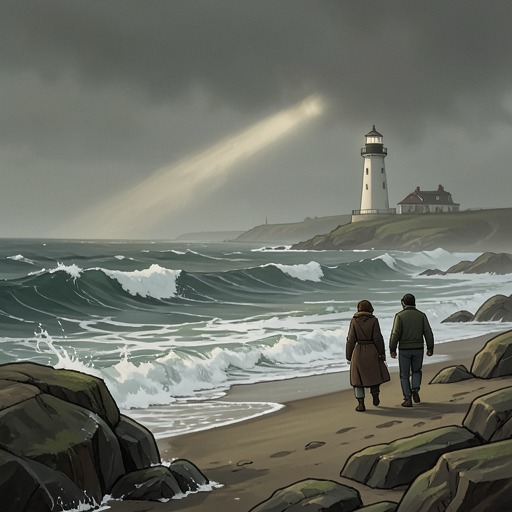
The book’s coastal scenes hold these meanings together without reducing the ocean to either refuge or threat. Wind can make a tent-site precarious; waves can drive through granite; water can also receive a swimmer beneath moonlight. For walkers with no fixed home, the shore is an exposed route they continue to choose, even as their freedom remains conditioned by money, weather, fatigue, and the need for shelter.